

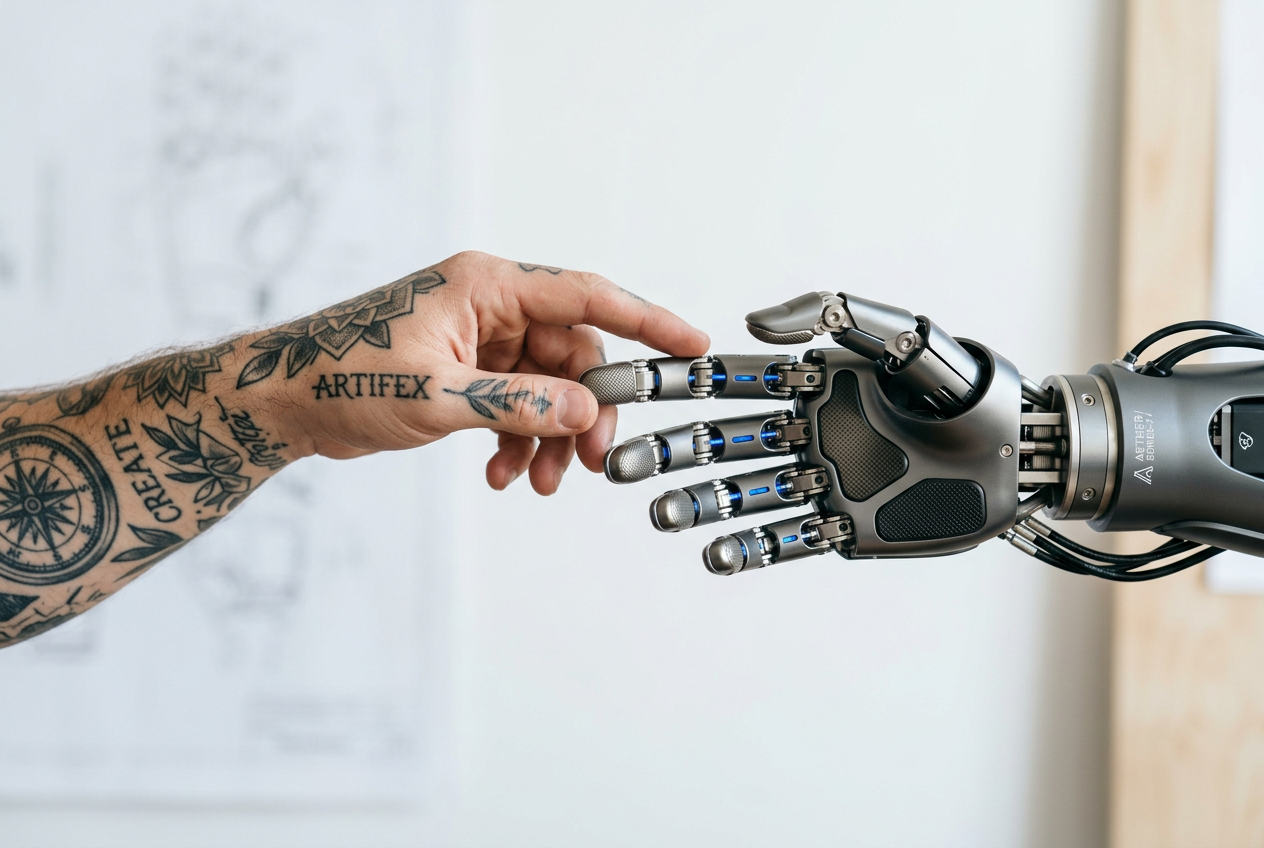
Let me tell you about a mistake thousands of businesses are making right now, and most of them have no idea.
A founder sits down, types a few words into an AI logo tool, Looka, Canva AI, Midjourney, take your pick. Ten seconds later, there’s a shiny mark on the screen. Looks great. Feels professional. They download it, drop it on the website, get it printed on business cards, and move on.
What nobody told them: that logo legally belongs to no one.

What nobody told them:
That logo legally belongs to no one.
No copyright. No authorship. No protection whatsoever.
If a competitor copies it tomorrow, and they can, there is nothing that the founder can legally do about it.
This isn’t some obscure legal debate. It’s the settled position of the U.S. Copyright Office, backed up by multiple federal court rulings. And it affects every business that’s skipped the human designer and gone straight from AI prompt to live brand.
So let’s talk about what the law actually says, why it matters more than most people realize, and importantly, what it takes to make a logo actually, legally yours.
What Copyright Law Says (And Has Always Said)
Here’s the thing about copyright law that most people don’t know: the rule that’s causing all this controversy with AI isn’t new. It didn’t change because of ChatGPT or Midjourney. It’s been there from the beginning.
Copyright in the United States and in most of the world requires a human author. Full stop. The U.S. Constitution gives Congress the power to protect the work of authors, and courts have always read that word to mean an actual human being who sat down and made creative decisions.
In 2023, a federal court in Washington, D.C., became the first to take this question head-on regarding AI outputs. The ruling left no wiggle room:

“copyright law protects only works of human creation” and “human authorship is a bedrock requirement.”
Federal court Washington D.C
Then, in January 2025, the U.S. Copyright Office released a major report specifically on AI and copyright. Same conclusion: a purely AI-generated work cannot be copyrighted. It doesn’t matter how clever your prompt was. It doesn’t matter how many options you sorted through before choosing one. The machine made the creative decisions. The machine has no legal rights. And because of that, you don’t either.
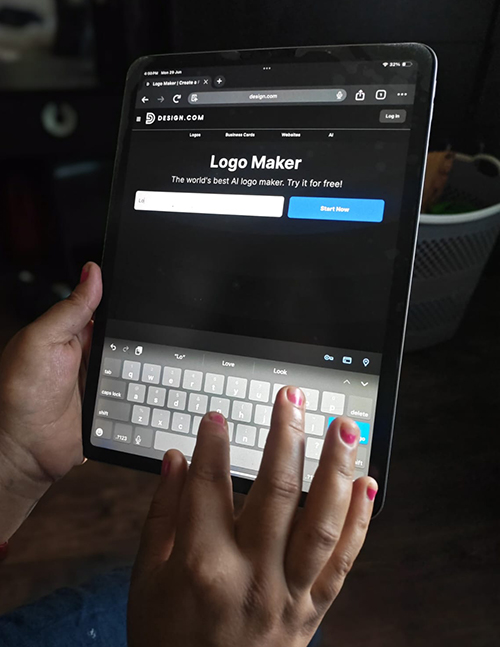
But I Wrote the Prompt. Doesn’t That Count?
I hear this all the time, and I get why it sounds reasonable. You had the idea, right? You told the AI what to make. Surely that’s something.
It’s not, at least not enough.
When you type a prompt, you’re giving instructions. What you’re not doing is deciding how the letterforms curve, how much negative space sits inside the icon, how the weight of the type balances against the mark, or how the whole thing holds together visually. The algorithm makes those calls — and it makes them statistically, based on patterns scraped from millions of existing images.
The Copyright Office looked at this exact scenario and was pretty direct about it: prompts alone don’t satisfy the human authorship requirement, because the expressive elements of the final design, the stuff copyright actually cares about, came from the machine, not you.
Here’s a simple way to think about it. If you walk up to a painter and say,
“Paint me a mountain at sunset, with purple and pink,”
You didn’t paint anything. The painter did. Now remove the painter and replace them with a computer running probability calculations. No one painted anything. No one authored anything. The result is a creative orphan; it exists, but nobody owns it.
What “No Copyright” Actually Means in Practice
This is where it gets real. “No copyright” isn’t just a technical legal footnote; it has direct consequences for your business.
Anyone can copy your logo and use it freely. Since there’s no copyright owner, there’s no legal mechanism to stop someone from lifting your mark and putting it on their own brand. You have no exclusive rights to enforce because you have no rights at all.
You might already be infringing on someone else. AI tools learn from existing images, including copyrighted ones. The logo you generated might be uncomfortably close to something that already exists, or something you’ve never seen. Without a human designer doing proper due diligence, you’re operating blind.
Your brand is sitting on quicksand. A logo is supposed to be one of your most valuable business assets. Building a brand identity on something with zero IP protection means the moment you grow big enough to be worth copying, you’re completely exposed.
It will come up eventually. Investors, lawyers, licensing partners, and anyone doing serious due diligence on your business will look at your IP. “We grabbed it from an AI tool and didn’t modify it” is not the answer that builds confidence.
How to Make Your AI-Generated Logo Copyright-Protected
Here’s where it gets more encouraging because the law doesn’t say AI tools can never touch a logo that ends up being protected. It says the human creative contribution has to be real, substantial, and clearly visible in the final result.
That’s exactly where a professional designer comes in. Not as a rubber stamp. Not to slightly tweak the colors. But to do the kind of creative work that the law recognizes as authorship.
Why AI Logo Design Needs Human Refinement to Be Copyrightable
Custom Typography and Letterform Work
AI tools pull from existing typefaces or spit out generic letter shapes. A human designer draws letterforms by hand, in vector, adjusting the curve of a terminal, the tension in a bowl, the spacing between characters until it feels exactly right. That’s not a prompt. That’s craft, and it’s legally attributable authorship.
Embedding Meaning Into the Mark
Think about the hidden arrow in the FedEx logo. The Amazon smile that stretches from A to Z. The bear is hidden in the Toblerone mountain. None of that happened by accident, and none of it could come from an AI tool that has no understanding of what a brand actually means or who it’s talking to.
A human designer digs into the brand, its story, its audience, its competitors, the feeling it needs to create, and then builds symbolism into the mark deliberately. That thinking process is exactly what copyright is designed to protect.
Color That Means Something
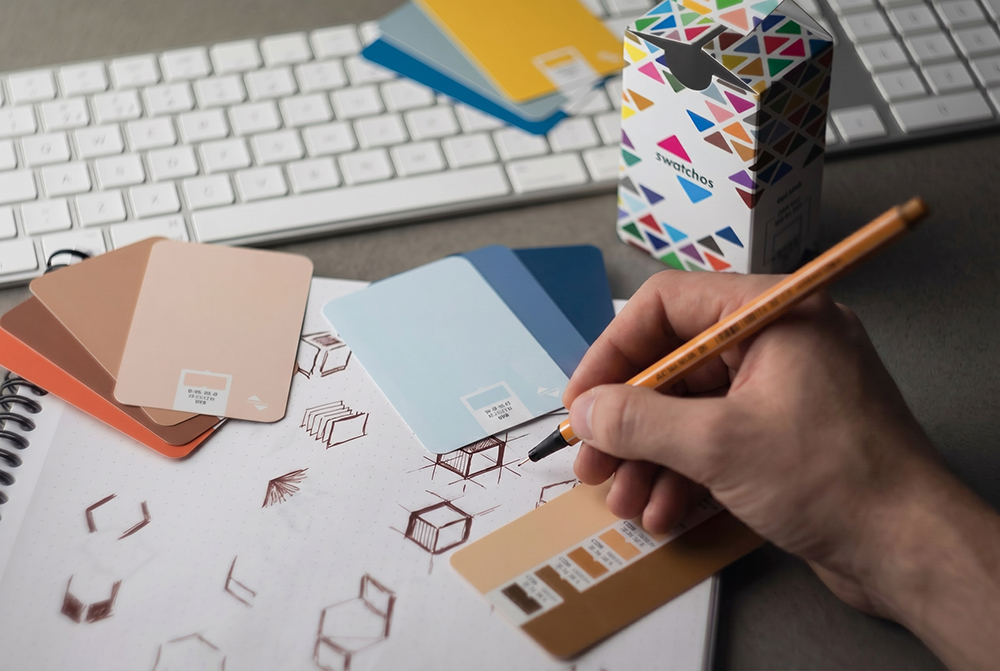
Generating a nice-looking color palette is something AI can do. Choosing colors that will work across every application your brand needs, print, digital, embroidery, dark backgrounds, light backgrounds, while considering cultural context, industry conventions, and emotional resonance? That’s judgment. Human judgment.
Geometric Precision and Visual Balance
Real logo design involves rebuilding marks on a grid, sometimes using golden ratio proportions, optical corrections, and precise alignment. The kind of decisions that make a logo feel right, even when you can’t explain why. AI doesn’t do this intentionally. A designer does.
Making It Actually Work Everywhere
A logo that only looks good on a website isn’t a logo system; it’s a JPEG. A professional designer thinks through every use case: tiny as a favicon, large on signage, one-color on a stamp, embroidered on a hat. Solving all of those problems requires creative decision-making at every step.
Two Businesses, Same AI Starting Point, Completely Different Outcomes
Picture two founders who both start with the exact same AI-generated logo concept.
Founder A downloads the file and goes straight to launch. Website, packaging, social media, the unaltered AI output is now their brand. According to the Copyright Office, that logo has no owner. If someone copies it, Founder A has no legal recourse at all.
Founder B takes the same concept to a brand identity designer. The designer rebuilds the mark in vector from scratch, hand-refines the icon geometry, reworks the typography, builds out a complete color and usage system, and documents every decision along the way. The human creative contribution is undeniable.
Founder B’s logo is registerable for copyright. It has legal protection. The brand has real, enforceable intellectual property behind it.
Same AI output as the starting point. Completely different legal reality. The only thing that changed was the human layer in between.
Why This Actually Matters for the Long Game
The logos that last Nike, Apple, FedEx, Airbnb weren’t generated. They were built, decision by decision, by designers who thought carefully about every line, every curve, every proportion. Each of those decisions is human authorship. Each one is legally protectable.
AI is genuinely useful in design. It can help explore ideas fast, break through creative blocks, and give clients something visual to react to. Nobody’s saying AI should be banned from the process.
But there’s a meaningful difference between a tool that helps a human create something and a machine that creates something instead of a human. The law draws that line. It always has.
A generated image is a starting point, not a finished brand. And an unrefined AI output isn’t just creatively incomplete, it’s legally unprotected property that nobody owns.
If You’re Already Using an AI Logo, Here’s What to Do
Don’t wait until someone copies you to figure this out.
1. Take it seriously, but don’t panic. The situation is fixable, but the sooner you address it, the better, especially if you’re growing.
2. Bring in a professional designer to audit what you have and do the work needed to establish clear human authorship. You don’t necessarily need to start over, but the refinement needs to be genuine and substantial.
3. Document everything. Sketches, revision notes, creative rationale, version history. If you ever have to prove your logo’s authorship in court or before the Copyright Office, that paper trail matters enormously.
4. Look into trademark registration in parallel. Even an AI-generated logo can potentially be protected as a trademark for your specific goods and services, but that’s a different type of protection with different rules. A good IP attorney can help you pursue both tracks smartly.
5. Be transparent if you register copyright. The Copyright Office requires you to disclose AI involvement and describe what the human contributions were. Trying to hide it isn’t just dishonest; it creates additional legal exposure.
The Bottom Line
Prompted, not authored. That’s the difference the law cares about.
When you type a description into an AI tool, you’re giving a machine instructions. You’re not making the creative decisions that copyright is designed to protect. The courts understand this. The Copyright Office has made it official policy. And the gap between “I prompted it” and “I authored it” is exactly where brand identities go unprotected.
A human designer isn’t just someone who makes things look nicer. In the age of AI-generated logos, a human designer is the person who gives your brand the one thing no AI tool can: legal authorship.
That’s not a design argument. That’s a business one.
FAQ
A: No. The U.S. Copyright Office has confirmed that purely AI-generated content cannot be copyrighted because copyright requires human authorship.
A: No. Prompts are instructions, not creative authorship. The expressive decisions are made by the algorithm, not the person.
A: A human designer must make substantial creative contributions — custom typography, symbolic refinement, geometric reconstruction that go clearly beyond the AI output.
You receive commercial rights to use it for your business, but you do not get exclusive copyright ownership. Since these platforms use a shared database of icons and fonts, the design is not uniquely yours, meaning you cannot trademark it.
Get a Logo That’s Legally Yours →
Custom Logo Design by ZakDesignz